Digital Ethiopia: From Digital Adoption to Connected Infrastructure
Ethiopia's digital transformation is entering a new phase.
For years, much of the conversation around digitalization has focused on access: getting people online, launching mobile applications, introducing digital payments and moving services from physical processes to digital platforms.
Those things remain important.
But the next challenge is different.
How do all these systems connect?
From digital products to digital infrastructure
A country can have hundreds of digital services without necessarily having a connected digital ecosystem.
A bank may have a mobile application.
A government agency may have an online portal.
A business may have an ERP system.
A customer may have a digital wallet and a digital ID.
But if these systems cannot communicate effectively, the user still experiences them as separate islands.
That is where interoperability becomes important.
Ethiopia's National Digital Payments Strategy 2026–2030 explicitly identifies interoperable infrastructure, broader digital adoption, trust, innovation and data exchange as important components of the country's next phase of digital payments development.
The strategy also identifies fragmentation in government payment systems as a challenge and calls for more unified infrastructure.
A connected digital economy
The direction is becoming increasingly visible.
Ethiopia has expanded digital financial services significantly, while initiatives around digital identity, e-government and digital payments are creating new pieces of national digital infrastructure.
In October 2026, EthSwitch unveiled a Unified Government Payment Platform, designed to provide common infrastructure connecting government billers, financial institutions and different payment channels.
This is an important concept because infrastructure can create possibilities that individual applications cannot.
Instead of every organization building isolated systems, shared infrastructure can allow different services to work together.
What this means for businesses
For Ethiopian businesses, digital transformation shouldn't necessarily mean:
“Let's build an app.”
The better question may be:
“What should our systems be able to connect to?”
That could mean:
• Payment systems • Digital identity • Customer databases • ERP platforms • Government services • Banking infrastructure • AI systems • Internal business workflows • Data platforms • Third-party APIs
The value increasingly comes from the connections between these systems.
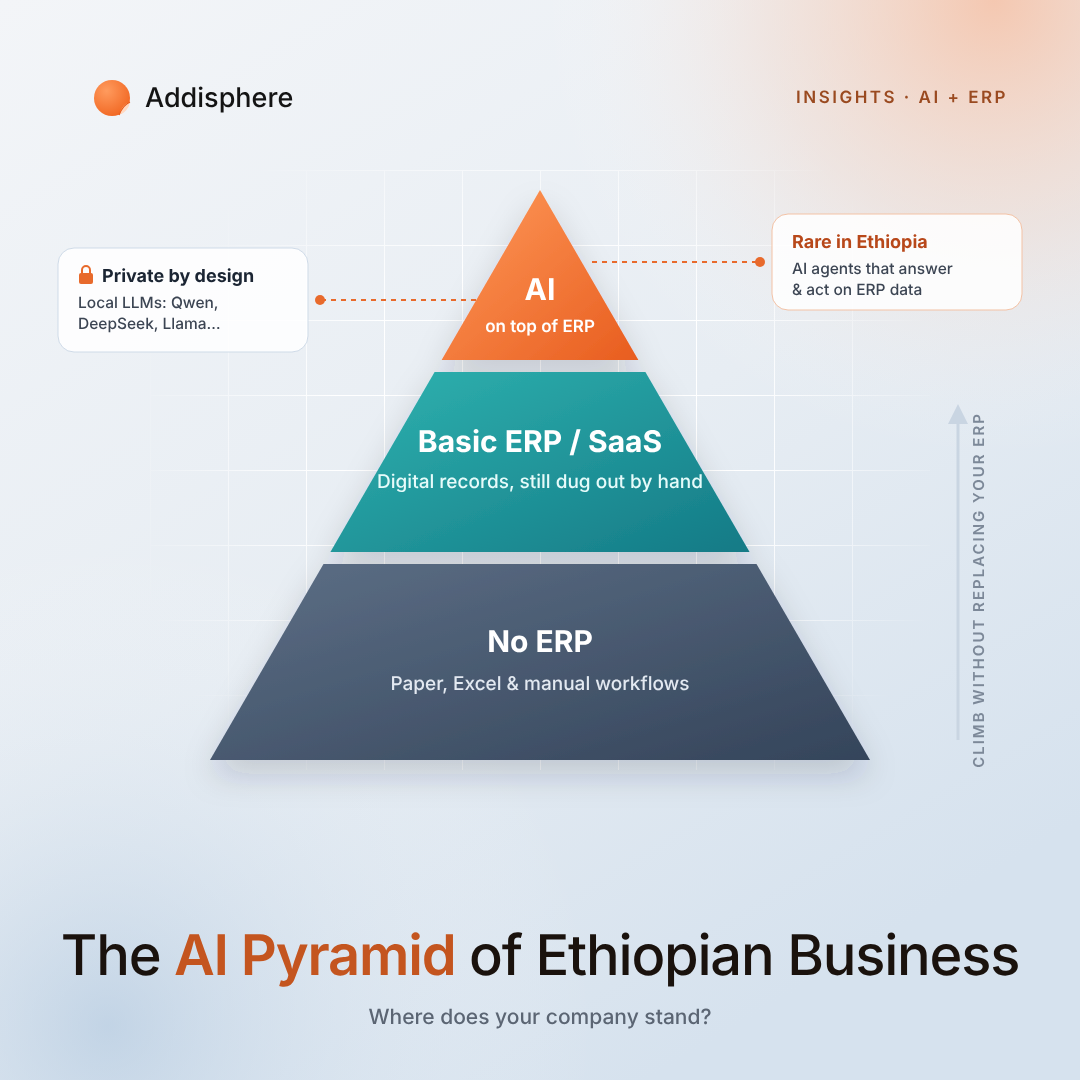
And then comes AI
AI makes this even more interesting.
AI can generate content, answer questions and analyze information.
But its real business value becomes much greater when it can interact with the systems a company already uses.
Imagine an AI system that doesn't simply answer:
“What happened to our sales?”
but can actually connect to the company's data, analyze transactions, identify patterns and initiate the next step in a workflow.
That requires more than an AI model.
It requires infrastructure, integrations, data and well-designed workflows.
Building for Ethiopia
Ethiopia is also increasingly discussing technological capacity beyond simply adopting technologies developed elsewhere.
At the STRIDE Ethiopia 2.0 Summit in September 2026, the Minister of Innovation and Technology described technological sovereignty as the ability to understand, adapt and develop technology according to Ethiopia's needs.
That creates an interesting opportunity for local technology companies.
We don't need to reinvent every technology.
But we can build systems that understand the local context.
Local businesses. Local payment infrastructure. Local workflows. Local languages. Local challenges. And local opportunities.
The next chapter
The first chapter of digital transformation was about getting digital.
The next chapter is about getting connected.
And after that, the opportunity is to make those connected systems increasingly intelligent.
At Addis Sphere, we see this as one of the most important opportunities for Ethiopian technology:
Build locally. Connect globally. Solve for the real world.
The future of Digital Ethiopia won't be defined by how many apps we build.
It will be defined by how effectively our digital systems work together.
Tagged with :