The AI Pyramid: Where Ethiopian Businesses Stand — and How to Reach the Top
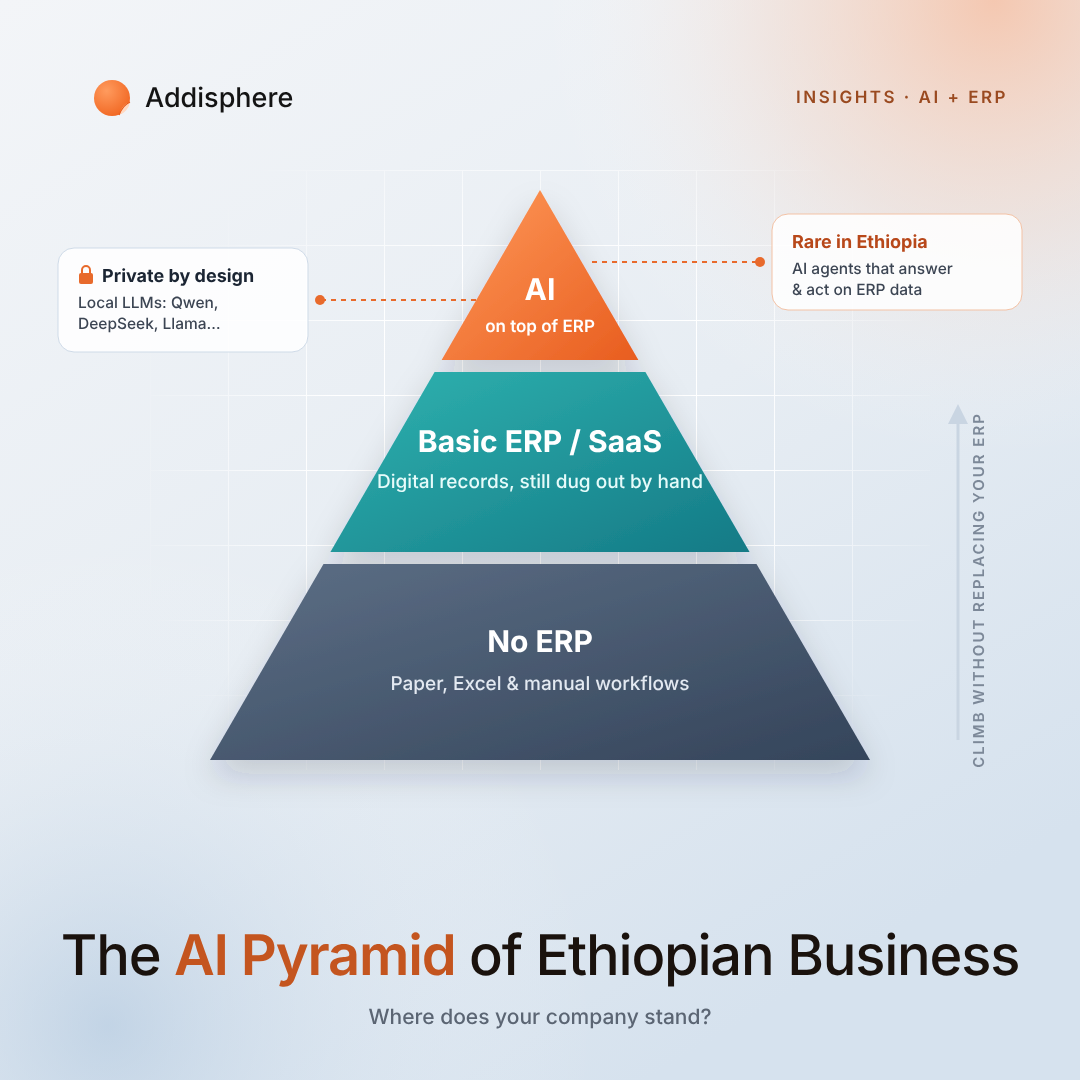
By Addis Sphere · October 21, 2026 Walk into most growing companies in Addis Ababa and ask a simple question: "Which of your customers are most likely to stop buying from you next quarter?" In many cases, nobody can answer — not because the information doesn't exist, but because it is buried in paper files, scattered spreadsheets, or deep inside an ERP that only a few people know how to query. At Addis Sphere we work with Ethiopian businesses across banking, insurance, hospitality, retail and the public sector. Looking across that market, we see companies sitting on three very different levels. We call it the AI pyramid.The three levels of the pyramid
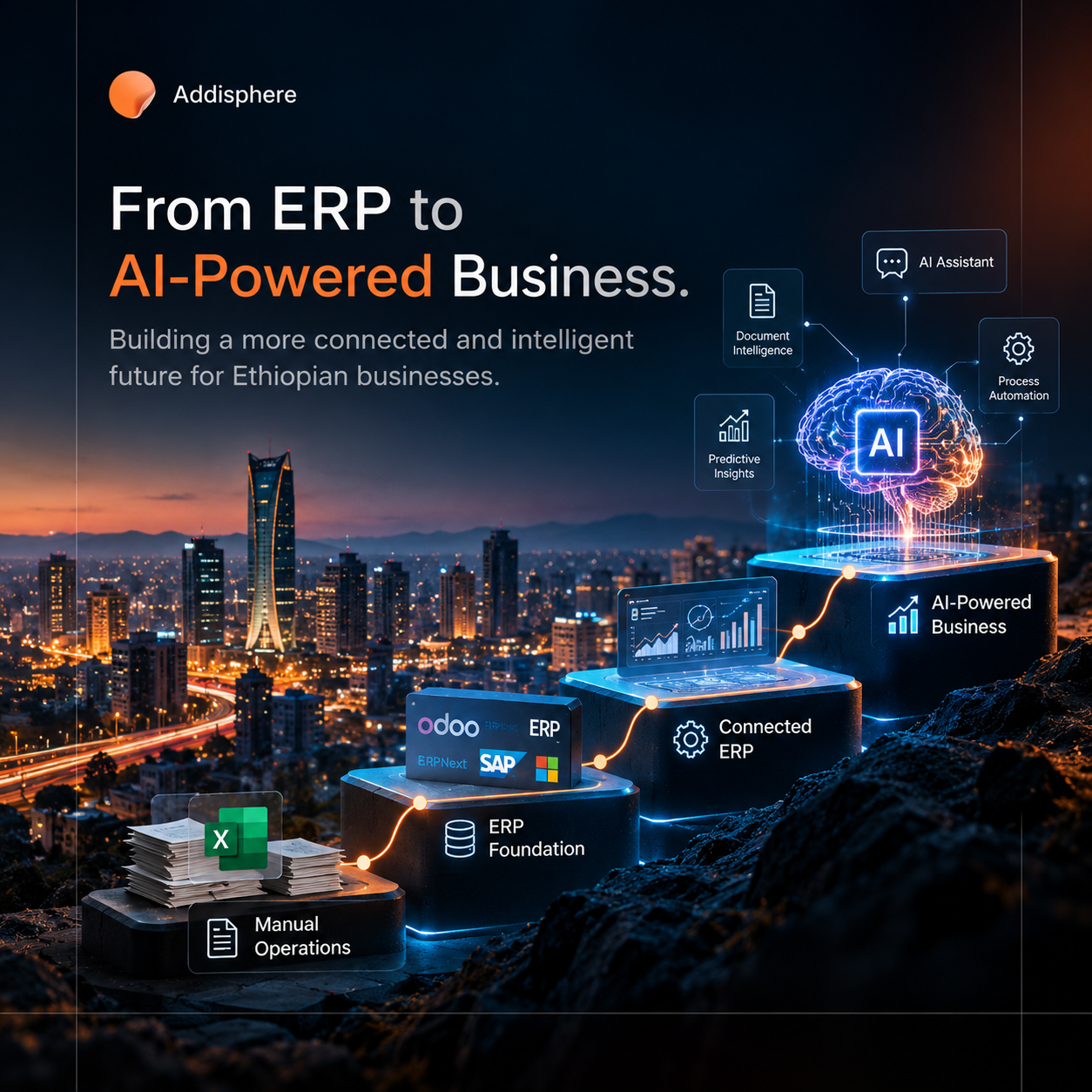
Level 1 (the base): Manual workflows, no ERP
This is still where a large share of Ethiopian businesses operate. Sales are recorded in receipt books, stock is counted by hand, and finance lives in Excel files that are emailed back and forth. Coordination happens in phone calls and Telegram groups. It works — until the business grows. Then the cracks show: reports take days to prepare, numbers don't match between departments, and decisions are made on gut feeling because the data arrives too late to be useful.Level 2 (the middle): A basic ERP or SaaS system
Many companies have taken the important step of digitising. They run an ERP — for finance, HR, procurement, inventory, sales — or use a SaaS platform built for their industry. The data is now in one place and it is digital. But here is the problem we see again and again: digital is not the same as accessible. To answer a real business question, someone still has to open five screens, apply filters, export to Excel, combine sheets and build a pivot table. A branch manager who wants to know why stock is piling up in one location has to wait for a report from IT or finance. The ERP stores the truth, but it doesn't explain it.Level 3 (the top): AI integrated on top of the ERP
This is the level very few Ethiopian companies have reached yet. Here, an AI layer sits on top of the existing ERP or company system. Instead of digging through records manually, people simply ask:- "Which branches had falling sales and rising inventory last quarter, and what changed?"
- "Show me every supplier invoice that is above the agreed contract price."
- "Summarise this month's customer complaints and group them by cause."
- "Which loan applications are missing documents?"
Why this matters in the Ethiopian context
Ethiopian businesses face some specific realities that make this AI layer especially valuable:- Scarce analyst capacity. Few companies can afford a dedicated data team. An AI agent gives every manager a way to get answers without writing queries.
- Multilingual teams and customers. Modern language models can work with Amharic and other local languages, so staff can ask questions and receive answers in the language they are most comfortable with.
- Fast growth, thin margins. When you open new branches or products quickly, catching problems early — stock outs, fraud patterns, late payments — protects cash flow.
- Legacy and mixed systems. Many organisations run an ERP next to older tools. AI can connect to several sources at once and give one combined answer.
"But what about privacy?" — The case for local LLMs
The most common objection we hear, especially from banks, insurers and government institutions, is this: "We cannot send our customer data or financial records to a foreign AI company." That is a fair concern — and it is exactly why the conversation about AI in Ethiopia must not stop at cloud services like Claude, ChatGPT or Gemini. Those are excellent tools, but they are not the only option. Today there is a strong family of open-weight large language models that a company can download and run on its own infrastructure:- Qwen (Alibaba) — strong at reasoning, coding and multilingual tasks
- DeepSeek — high-quality reasoning models released with open weights
- Llama (Meta), Gemma (Google) and Mistral — widely used, well-supported model families
- Your data never leaves your building. Customer records, salaries and financial statements stay on infrastructure you control.
- Easier compliance. Keeping data in-country makes it simpler to meet regulatory expectations, such as those from the National Bank of Ethiopia and Ethiopia's personal data protection law.
- Predictable costs. No per-question API bill that grows with usage; you pay for the hardware once and run as many queries as you need.
- Works with limited connectivity. A local model keeps working even when the internet connection is slow or interrupted.
- Can be fine-tuned on your domain. A local model can be adapted to your terminology, products and documents.
How a company climbs from the middle to the top
Moving to Level 3 does not have to be a huge, risky project. At Addis Sphere we usually approach it in four steps:- Discover. Identify the 5–10 questions your managers ask most often and the ERP data that answers them.
- Connect. Build secure, read-only connections between your ERP or SaaS system and the AI layer, with role-based access so people only see what they are allowed to see.
- Choose the model. Decide between a local LLM (Qwen, DeepSeek, Llama…), a cloud model, or a hybrid — based on your data sensitivity, budget and infrastructure.
- Pilot, then scale. Start with one department — finance, sales or customer service — measure the time saved, then expand.
The bottom line
The companies that will lead Ethiopia's next growth phase are not necessarily the ones with the most data. They are the ones that can ask their data questions and get answers fast — safely, in their own language, and on their own terms. Where is your company on the AI pyramid today? Whether you are starting with your first ERP or ready to put an AI agent on top of the one you have, Addis Sphere can help you take the next step. Let's talk: info@addissphere.com · +251 910 565 994 · addissphere.com
Tagged with :