Is AI Actually Cheaper Than Hiring People in Ethiopia?
A practical look at automation costs, human labor, and the decisions Ethiopian businesses need to make before investing in AI.
The question behind the AI hype
Artificial intelligence is increasingly part of conversations about business growth. From customer support and document processing to reporting and internal knowledge search, AI tools promise to help teams work faster and handle more requests. That promise raises a practical question for businesses in Ethiopia: is it actually cheaper to automate a task than to hire someone to do it?
There is no universal answer. AI can reduce the cost of some repetitive tasks, especially when the volume is high and the process is well-defined. But automation also brings setup costs, ongoing technical work, risks, and a need for human oversight. The right comparison is not an AI subscription against a monthly salary. It is the full cost and outcome of two different ways of getting work done.
First, compare the full cost—not just the visible price
For an AI workflow, a business may need to account for software or API usage, implementation, integration with existing systems, data preparation, staff training, monitoring, maintenance, security controls, and the cost of correcting mistakes. If the workflow handles sensitive information or makes decisions that affect customers, the cost of review and accountability matters too.
For a human-led workflow, the calculation may include salary, benefits where applicable, recruitment, onboarding, management, training, tools, turnover, and the time required to complete the work. People also bring capabilities that are difficult to capture in a simple cost-per-task calculation: context, empathy, negotiation, judgment, and the ability to handle unusual situations.
The fairest comparison measures the cost of achieving an acceptable result. A low-cost system that produces errors, frustrates customers, or requires constant intervention may not be cheaper in practice.
Ethiopia’s context makes the question more specific
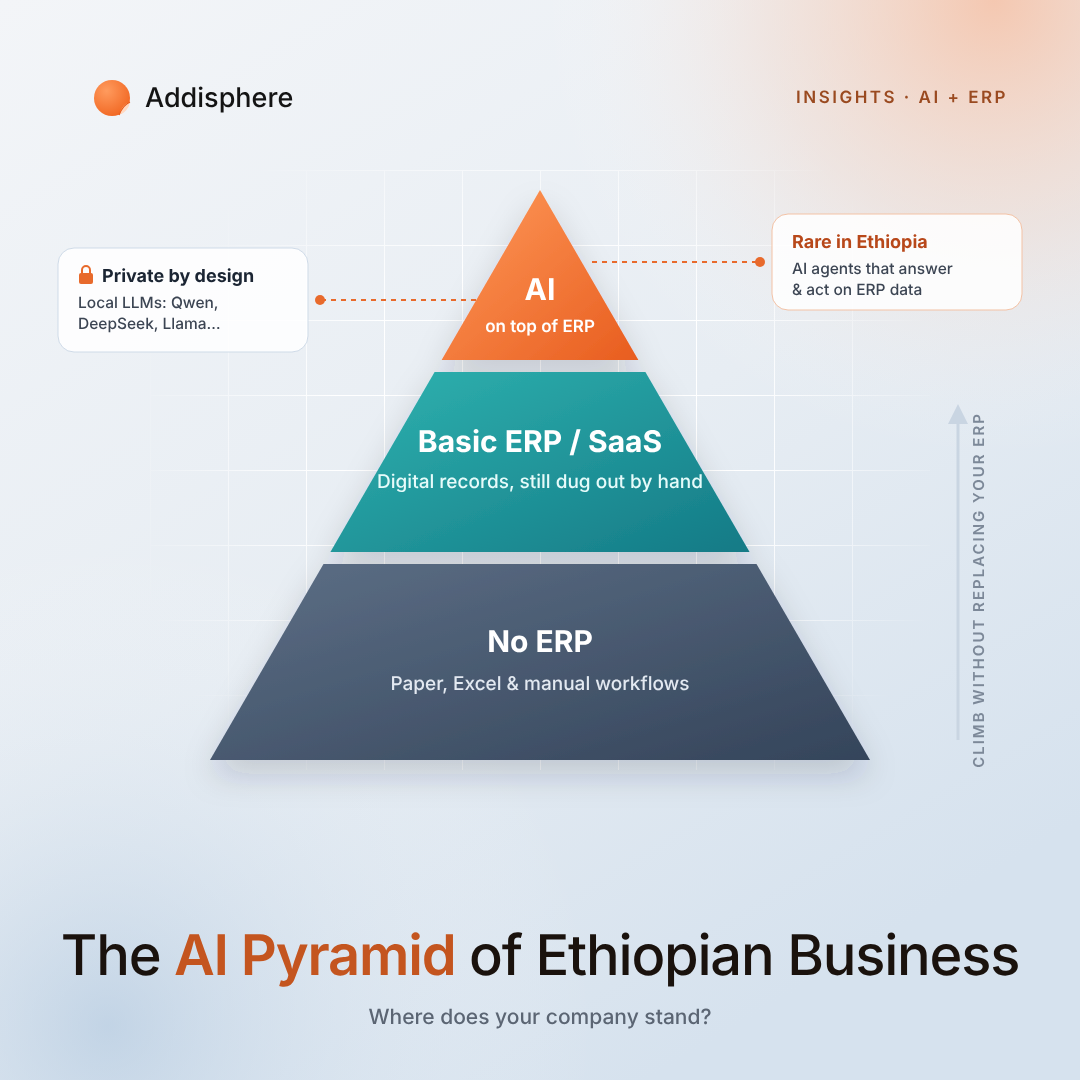
Businesses in Ethiopia operate across very different conditions. Some have modern digital platforms and structured data; others rely on paper records, spreadsheets, messaging apps, or several tools that do not share information easily. Connectivity, access to technical skills, data quality, language needs, and integration requirements can all influence whether an AI project is practical.
A 2025 GSMA report on AI in Ethiopia discusses opportunities across sectors including agriculture, finance, healthcare, education, and public services. It also highlights enabling factors such as data availability, AI talent, and computing capacity. These are reminders that successful AI adoption depends on more than access to a model or chatbot.
Ethiopia’s digital foundations are also changing. The World Bank reported in 2025 that digital-sector investments and reforms had expanded access to mobile and internet services in recent years. That progress creates opportunities, but it does not mean every organization is ready to automate every process today.
The hidden cost: getting the process ready
Imagine a business that wants AI to answer customer questions about orders. If order information is scattered across paper notes, a spreadsheet, and a separate accounting tool, the AI cannot reliably answer customers just because a chatbot has been added to the website.
The business may first need to define a consistent process, organize its records, connect the systems, decide which information the AI can access, and create a way to escalate uncertain cases to a person. Those steps can be valuable even without AI: they can reduce duplicate work, make information easier to find, and improve reporting. They are also part of the true cost of an automation project.
In other words, the first investment may not be AI itself. It may be building the digital foundation that allows automation to work reliably.
Where AI may make economic sense
AI is worth evaluating when a task is repetitive, has enough volume to justify setup, follows reasonably clear rules, and can be checked against a reliable source of truth. Examples might include classifying incoming requests, drafting responses for staff review, extracting information from standard documents, summarizing long records, or helping employees search internal knowledge.
These are starting points, not automatic recommendations. A business should test whether the system performs accurately on its own real examples, including edge cases and local-language content where relevant. It should also decide what happens when the AI is uncertain or wrong.
Where people remain essential
Not every task should be automated. Work that depends on trust, empathy, negotiation, complex judgment, physical presence, or responsibility for consequential decisions may still need a person at the center. Even in automated workflows, people often remain responsible for reviewing outputs, resolving exceptions, maintaining relationships, and improving the process.
This is why the question should not be reduced to whether AI can replace an employee. A more useful question is which parts of a job can be improved by technology—and how the organization will use the time and capacity that become available.
A simple way to evaluate an automation project
- 1. Choose one specific task. Avoid trying to automate an entire department at once. Start with a workflow that has a clear beginning, end, and measurable outcome.
- 2. Measure the current baseline. Track time per task, volume, error rates, delays, rework, and the fully loaded cost of the current process.
- 3. Estimate the full automation cost. Include setup, integration, usage, maintenance, oversight, staff training, and the cost of failures or manual fallback.
- 4. Run a controlled pilot. Test on real but appropriately protected data. Compare quality and total effort against the existing process, not just speed.
- 5. Keep a human fallback. Define who checks exceptions, handles complaints, and takes responsibility when the system is uncertain.
- 6. Review the result before scaling. Expand only if the pilot produces a meaningful improvement in cost, quality, speed, or customer experience.
So, is AI cheaper than hiring in Ethiopia?
Sometimes—but the answer depends on the work being done and the conditions in which it is done. Automation may offer value when it handles repetitive tasks at scale and the process is ready for it. Hiring or investing in existing employees may be the better option when work requires judgment, relationship-building, adaptability, or a level of flexibility that the automated system cannot provide.
The smartest decision is not to automate simply because AI is available, or to avoid it simply because human labor appears affordable. It is to compare the total cost, the quality of the outcome, the risks, and the impact on the people doing the work.
For many businesses, the practical path is to start small: understand the process, improve the data, test one useful workflow, and measure the results. AI should solve a real business problem—not become another tool that the business has to manage.
A final question for business leaders
If an AI system can perform part of a task faster, but still needs people to guide it, check it, and handle exceptions, where does the real value come from?
At Addis Sphere, we believe that is the conversation worth having. Digital transformation should begin with the problem, the people, and the process—not the technology alone.
Sources and further reading
- GSMA (April 2025), AI in Ethiopia: Promising use cases for development. Overview of Ethiopia’s emerging AI ecosystem, opportunities, and enabling factors.
- World Bank (June 2025), Empowering Ethiopians by Laying the Digital Foundations for Economic Growth. Summary of recent progress in digital access and infrastructure.
Editorial note: This article intentionally avoids declaring AI universally cheaper than human labor. Before publication, Addis Sphere can strengthen it with a verified local example or a transparent cost calculation for a specific workflow.
Tagged with :