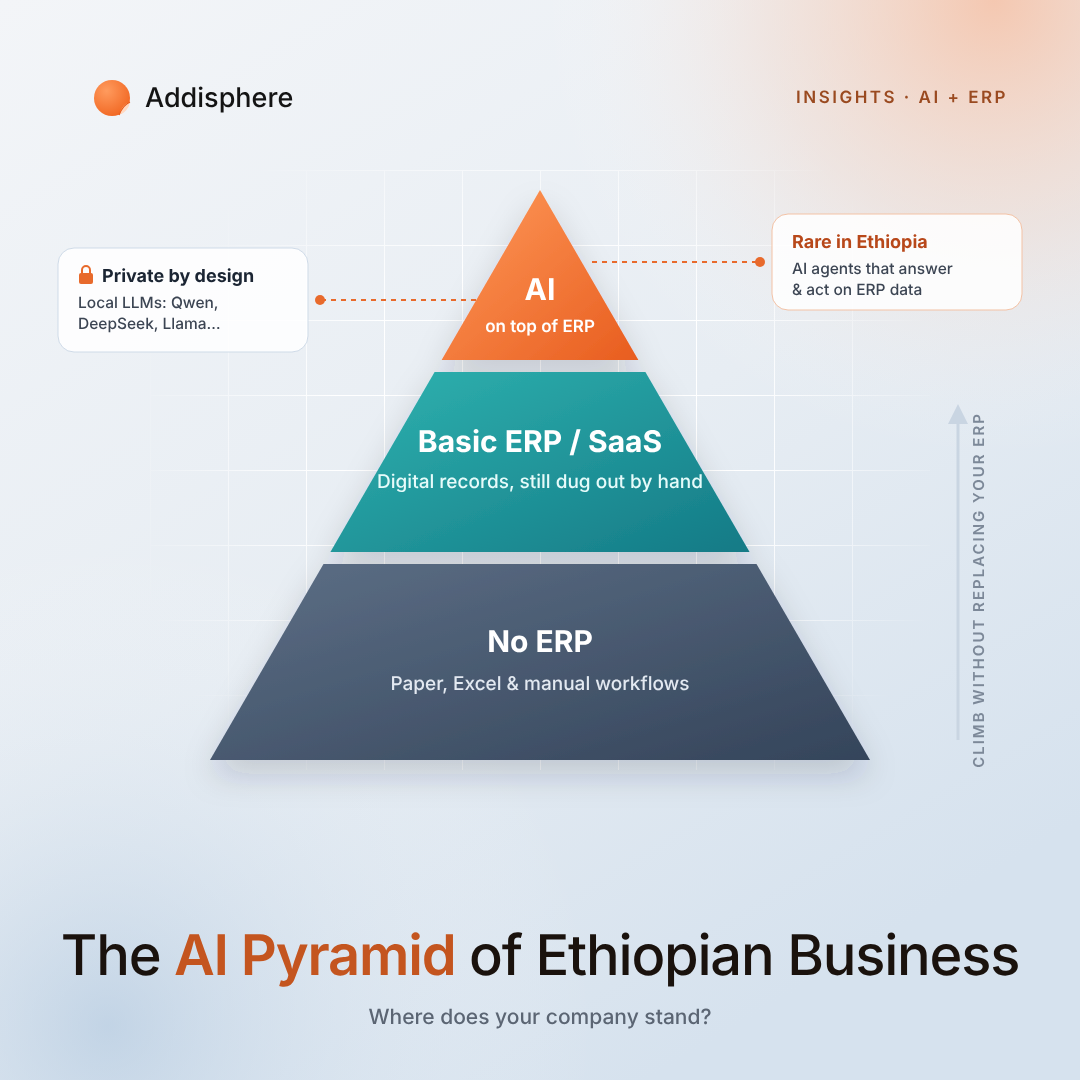
The Three Stages of Enterprise Technology in Ethiopia
Not every organization is at the same level of digital maturity. A useful way to think about the market is through three broad stages.1. Businesses without ERP
Many organizations still depend heavily on spreadsheets, paper documents, disconnected applications, messaging platforms, and manually maintained records. When information is scattered across different places, even basic questions can become difficult:- How much did we sell this month?
- What do we currently have in stock?
- Which customers still owe us money?
- What are our largest expenses?
- Which suppliers are performing well?
- How profitable is each product or branch?
- What happened to our cash flow last quarter?
2. Businesses that already have ERP
The second group is different. These organizations already use an ERP such as Odoo, ERPNext/Frappe, SAP, Microsoft Dynamics 365, Oracle Fusion, or another business management platform. The challenge is no longer simply: "Where is our data?" The data is already there. The bigger question becomes: How can employees and decision-makers get more value from the data they already have? Modern ERP platforms are increasingly moving in this direction. Odoo, for example, now provides AI capabilities that can answer questions in natural language, work with business records, generate content, and support configurable AI agents. SAP is developing Joule as an AI experience that works across business processes and can use enterprise context to help execute workflows. Microsoft is integrating Copilot and AI agents into Dynamics 365 across areas such as finance and supply chain management. Oracle is embedding AI agents into ERP processes including payables, cash processing, billing, assets, and financial operations. The direction is clear: ERP is becoming an intelligent operating layer rather than simply a system for storing transactions.ERP + AI: The Next Layer
An ERP records what happened. AI can help organizations understand what is happening, why it is happening, and what could happen next. Consider a finance manager using an ERP. Traditionally, they may need to navigate several reports to understand revenue, expenses, outstanding invoices, and cash flow. With an AI layer connected to the ERP, the interaction can become much more natural: "Show me the biggest changes in expenses this month." Or: "Which customers have overdue invoices above 100,000 birr?" Or: "Compare this month's sales with the previous three months." Or: "Which products are selling faster than expected?" Instead of forcing every employee to understand the structure of the database and every ERP screen, the system can become easier to interact with through natural language.AI Can Go Beyond Questions
The biggest opportunity is not simply putting a chatbot on top of an ERP. The more important opportunity is AI-assisted workflows. For example, an AI system could help:Finance
- Extract information from invoices.
- Categorize transactions.
- Identify unusual transactions.
- Summarize financial performance.
- Assist with reconciliation.
- Identify overdue payments.
- Prepare management reports.
- Answer questions about financial records.
Sales
- Summarize customer history.
- Identify potential sales opportunities.
- Analyze sales trends.
- Generate customer communication.
- Prioritize leads.
- Explain changes in sales performance.
Procurement
- Analyze supplier performance.
- Compare purchasing patterns.
- Identify unusual price changes.
- Summarize purchase orders.
- Assist procurement teams with supplier communication.
Inventory
- Monitor stock levels.
- Identify unusual inventory movements.
- Analyze product demand.
- Highlight potential stock shortages.
- Help employees investigate inventory discrepancies.
Human Resources
- Summarize employee information.
- Assist with HR documentation.
- Answer questions about company policies.
- Help organize employee workflows.
- Generate reports for management.
Management
Instead of waiting for someone to manually prepare a report, management could ask: "What changed in the business this week?" The AI layer can analyze relevant business data and produce a structured summary.What About Businesses That Already Have SAP, Odoo, ERPNext, or Another ERP?
They do not necessarily need to replace their ERP. This is an important distinction. AI adoption does not always mean replacing existing software. A company that has invested years into SAP does not necessarily need to throw away SAP. A company running Odoo does not necessarily need another ERP. A company using ERPNext/Frappe can potentially extend what it already has. The same principle applies to Microsoft Dynamics, Oracle, and other enterprise platforms. The opportunity is to build an intelligence layer around the existing business system. That can include:- AI assistants
- AI agents
- Business intelligence
- Natural-language querying
- Document intelligence
- OCR
- Workflow automation
- Predictive analytics
- Knowledge retrieval
- Internal company knowledge assistants
- Automated reporting
- Process-specific AI agents
The Ethiopian Opportunity
For Ethiopia, this creates a particularly important opportunity. The question should not be: "Should Ethiopian businesses use AI?" The more useful question is: "What does each organization need before AI can create real value?" For one company, that may mean implementing ERP for the first time. For another, it may mean cleaning and centralizing existing business data. For another, it may mean integrating AI into an existing ERP. And for a more mature organization, it may mean building AI agents that can work directly with business workflows. This is why there cannot be a single technology strategy for every Ethiopian organization.Addisphere's Approach
At Addisphere, we see enterprise transformation as a journey rather than a single software installation.Stage 1 — Establish the digital foundation
For organizations without an ERP, we help establish structured business systems. This can include:- Finance
- Accounting
- Sales
- Purchasing
- Inventory
- HR
- CRM
- Projects
- Reporting
Stage 2 — Modernize the existing ERP
For organizations that already have ERP, the focus can shift toward integration, customization, automation, data quality, and better user experiences. The objective is not to replace technology simply for the sake of replacing it. The objective is to make the existing technology more useful.Stage 3 — Add AI
Once reliable business data and workflows exist, AI can be introduced where it provides measurable value. This could include: Ask your business data Employees can interact with business information using natural language. Automate repetitive work AI can assist with documents, reports, classification, communication, and other repetitive processes. Business intelligence AI can help identify trends, anomalies, and important changes across business data. AI agents Instead of simply answering questions, AI agents can be connected to approved business tools and workflows to assist with specific tasks. Document intelligence Invoices, receipts, contracts, reports, and other documents can be processed using OCR and AI. Knowledge assistants Organizations can build internal assistants grounded in their own policies, procedures, documents, and business information.The Goal Is Not "More AI"
There is an important principle behind this approach: AI should solve a business problem, not become another technology project. A company does not become digitally mature simply because it has a chatbot. If employees still manually transfer data between spreadsheets, if financial information is fragmented, if inventory records are unreliable, or if important documents are inaccessible, adding an AI interface alone will not solve the underlying problem. The foundation matters. Good data enables useful AI. Good workflows enable useful automation. Good governance enables trustworthy AI. And a good ERP can provide the operational foundation on which these capabilities are built.From ERP to Intelligent Operations
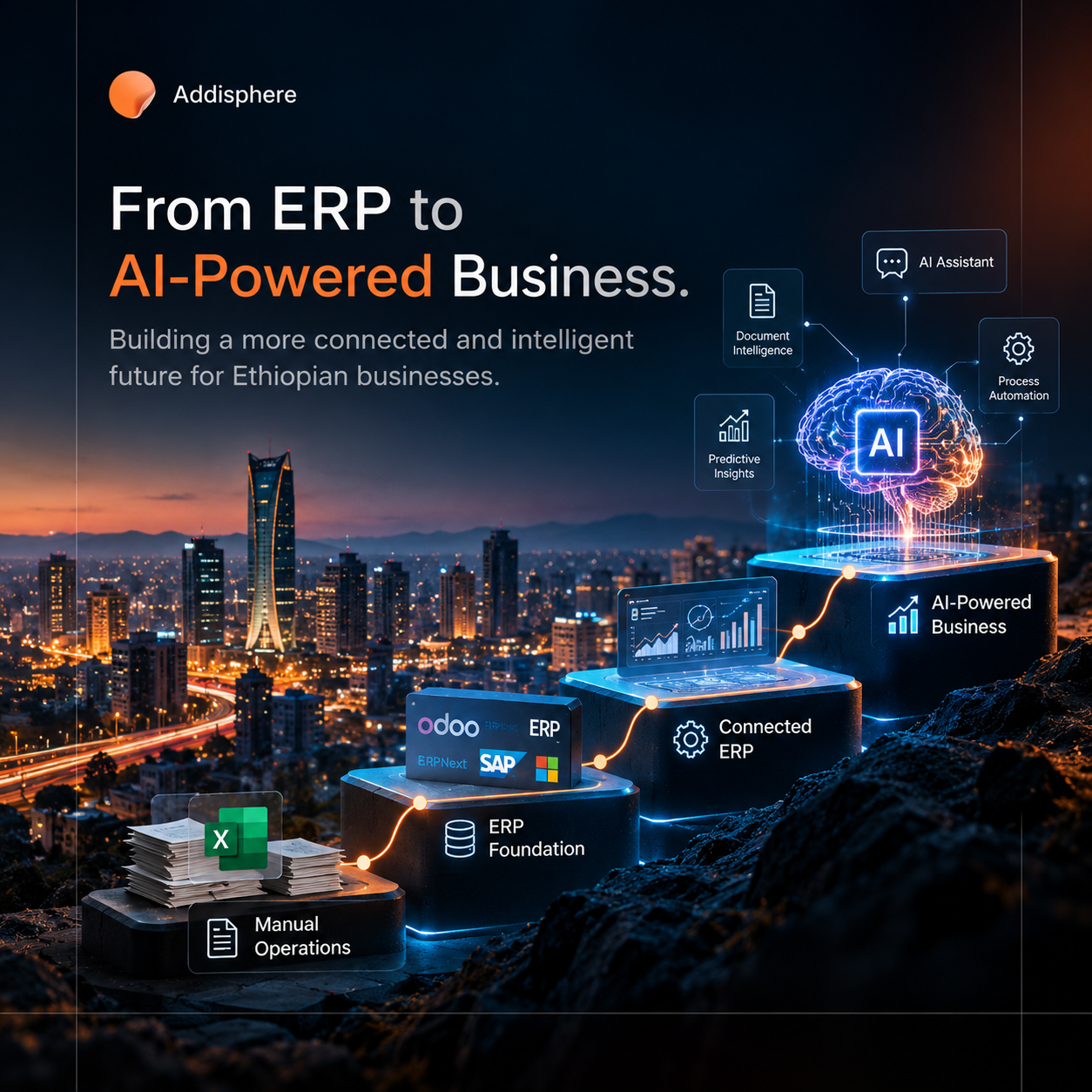
The evolution can be summarized simply: Manual Operations ↓ Digital Systems ↓ ERP ↓ Connected ERP ↓ ERP + AI ↓ AI-Assisted Operations ↓ AI-Enabled Business Processes The destination is not simply an ERP with a chatbot attached to it. The destination is an organization where employees can spend less time searching for information, moving data between systems, preparing repetitive reports, and performing routine administrative work—and more time making decisions, serving customers, and growing the business.Building This Future in Ethiopia
Ethiopian businesses do not need to copy the technology journey of another country exactly. The technology needs to fit the organization, its people, its processes, its data, and the realities of the Ethiopian market. That is where Addisphere sees its role. We want to help organizations move through the technology journey one stage at a time: If you don't have ERP → let's build the foundation. If you already have ERP → let's make it more connected and useful. If you have ERP but lack AI → let's add intelligence to your existing systems. If your organization is ready for advanced automation → let's build AI-powered workflows and agents around your business processes. The future of enterprise software in Ethiopia does not have to begin with replacing everything. It can begin with understanding where your organization is today—and building the next layer from there. ERP gives the business structure. Data gives the business visibility. AI gives the business intelligence. Automation turns intelligence into action. And together, these technologies can help build a new generation of Ethiopian businesses.About Addisphere
Addisphere is a technology company focused on building digital solutions for businesses and organizations in Ethiopia. Our approach combines software engineering, enterprise systems, data, automation, and artificial intelligence to help organizations move from fragmented manual processes toward connected and intelligent operations. The journey to AI starts with the right foundation.
Tagged with :