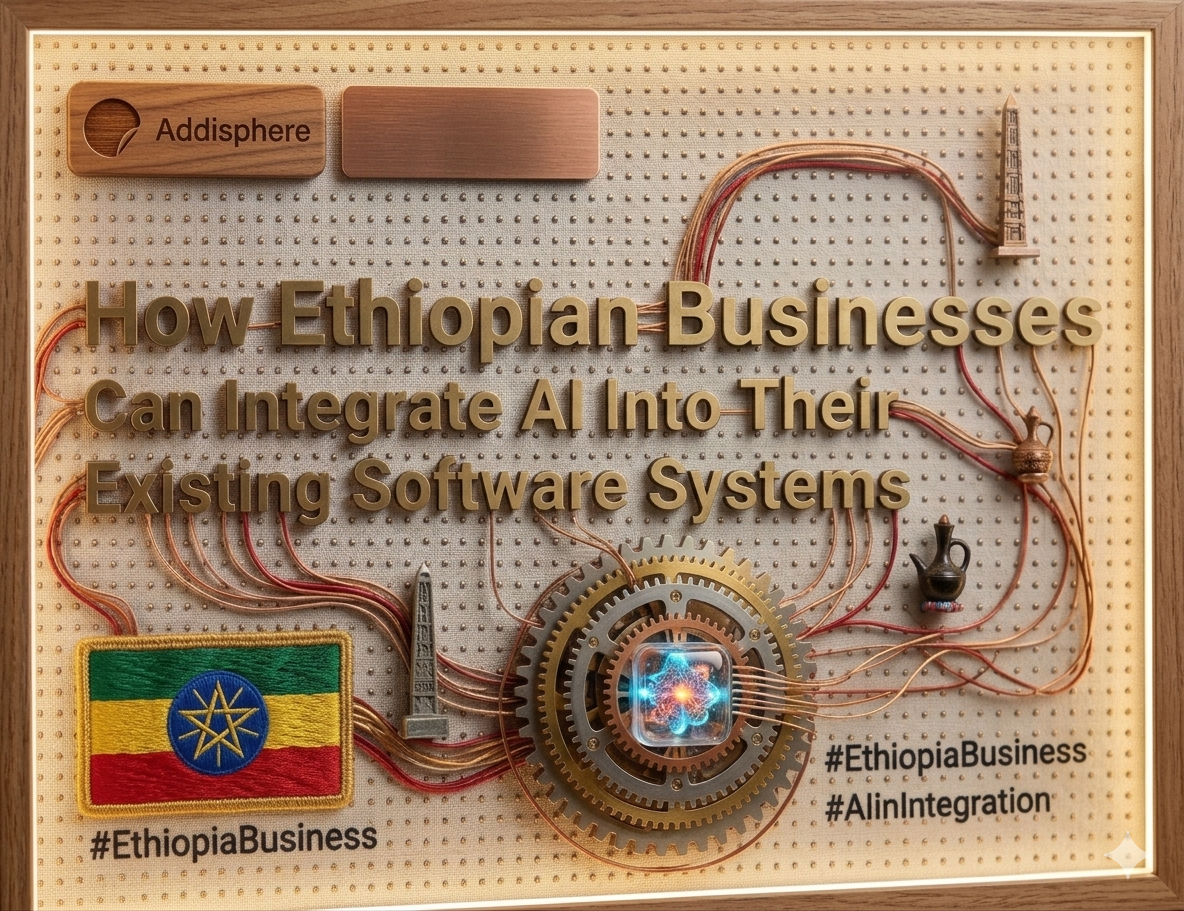
How Ethiopian Businesses Can Integrate AI Into Their Existing Software Systems
Digital transformation is growing rapidly across Ethiopia.
Today, many businesses already use software to manage operations:
- ERP systems
- accounting platforms
- QR menu systems
- banking applications
- logistics software
- healthcare systems
- school management platforms
- customer support systems
For many companies, this was the first stage of modernization: moving from manual operations to digital systems.
Now a second transformation is beginning.
Not replacing software.
Making existing software intelligent through AI integration.
AI Integration Is Different From Building an AI Company
When people hear “AI,” they often imagine:
- building a chatbot like ChatGPT
- creating robots
- replacing employees
- rebuilding entire systems from scratch
In reality, most businesses do not need to rebuild everything.
The biggest opportunity for Ethiopian businesses is integrating AI into the software systems they already use.
This is more practical, more affordable, and easier to scale.
AI becomes an intelligent layer on top of existing systems.
Instead of software only storing data, AI helps businesses understand, automate, predict, and interact with that data.
Why Existing Software Systems Are Perfect for AI
Most business software already contains valuable operational data.
For example:
- customer transactions
- inventory records
- employee activities
- supplier information
- patient histories
- restaurant orders
- financial reports
- customer support conversations
- This data is extremely valuable for AI systems.
The companies that benefit most from AI will not necessarily be the companies with the biggest budgets.
They will be the companies that already have organized business data and use AI effectively on top of it.
AI Integration in ERP Systems
ERP systems are already used by many medium and large businesses in Ethiopia.
Most ERP systems manage:
- inventory
- procurement
- accounting
- HR
- payroll
- operations
- reporting
But most ERPs are still passive systems.
Employees must manually:
- search reports
- analyze spreadsheets
- identify problems
- generate summaries
- make predictions
- AI can change this completely.
What AI Can Add to ERP Systems
AI Reporting Assistant
Instead of reading long reports, managers can ask:
- “What were the highest expenses this month?”
- “Which products are underperforming?”
- “Summarize this week’s sales.”
- The AI can generate instant summaries and insights.
Inventory Prediction
AI can analyze:
- sales patterns
- seasonal demand
- supplier delays
- customer behavior
And predict:
- stock shortages
- overstock situations
- reorder timing
This reduces operational waste and improves planning.
AI Procurement Recommendations
AI can help procurement departments identify:
- supplier trends
- pricing anomalies
- purchasing inefficiencies
- optimal reorder timing
Instead of reactive purchasing, businesses become proactive.
Internal Knowledge Assistant
Employees often ask repetitive questions:
- HR policies
- leave procedures
- procurement rules
- operational guidelines
- An internal AI assistant connected to company documents can answer these instantly.
This saves time and improves internal efficiency.
AI Integration in Restaurant and Hospitality Systems
Many restaurants in Ethiopia are adopting QR code menus and digital ordering systems.
But most systems only display static information.
AI can transform the customer experience completely.
AI-Powered QR Menu Systems
Instead of simply displaying food items, AI can:
- recommend dishes
- explain ingredients
- support voice interaction
- personalize suggestions
- assist customers in multiple languages
Example Customer Experience
A customer scans a QR code.
Instead of reading a static menu, they can ask:
- “What is your most popular spicy dish?”
- “Which foods are best for fasting days?”
- “Recommend a combo under my budget.”
- “What do you recommend for someone trying Ethiopian food for the first time?”
- AI can respond instantly.
This creates a more interactive and premium dining experience.
Voice AI for Restaurants
Voice integration is another major opportunity.
Customers could:
- speak in Amharic
- ask for recommendations
- place orders through voice interaction
- request ingredient explanations
- This can improve accessibility and customer engagement.
AI Integration in Healthcare Systems
Healthcare systems generate massive amounts of data every day.
Doctors and healthcare workers often spend significant time:
- reviewing patient histories
- writing reports
- searching records
- documenting notes
AI can help reduce administrative workload.
AI-Assisted Healthcare Features
Patient History Summarization
AI can summarize:
- previous diagnoses
- medications
- treatments
- lab results
This helps doctors review patient information faster.
Medical Documentation Assistance
Voice-to-text AI can help doctors generate medical notes automatically during consultations.
This reduces manual documentation time.
AI Recommendation Systems
AI can assist healthcare professionals by:
- identifying possible risk factors
- detecting unusual patterns
- suggesting treatment references
- highlighting drug interactions
AI should support medical professionals, not replace them.
The goal is faster and more informed decision-making.
AI in Banking and Financial Systems
Banks and fintech companies already operate with large amounts of transactional data.
AI integration can improve:
- fraud detection
- customer support
- spending analysis
- financial recommendations
- loan risk assessment
- multilingual digital banking experiences
Fraud Detection
AI systems can analyze unusual transaction behavior in real time and help flag suspicious activities faster than traditional systems.
AI Customer Support
Instead of customers waiting for support, AI assistants can answer:
- account questions
- transaction issues
- service guidance
- loan inquiries
This improves customer experience while reducing support workload.
Privacy and Data Security: One of the Most Important AI Challenges
As AI adoption grows, one major concern becomes increasingly important:
Data privacy.
This is especially critical for:
- government institutions
- banks
- healthcare organizations
- insurance companies
- telecom providers
- large enterprises handling sensitive information
In many cases, organizations cannot send confidential data to external AI platforms or public servers.
For example:
- governments may restrict sensitive national data from leaving internal systems
- banks must protect financial records and customer transactions
- hospitals must secure patient histories and medical information
This means AI integration must also consider:
- security
- compliance
- data ownership
- infrastructure control
Why Fine-Tuning Open-Source LLMs Matters
This is where fine-tuning open-source LLMs (Large Language Models) becomes extremely important.
Instead of depending entirely on external AI providers, organizations can use open-source AI models and adapt them to their own environments.
These models can be:
- hosted internally
- deployed on private infrastructure
- connected securely to company systems
- customized using organization-specific data
This creates a more privacy-focused AI architecture.
Why This Matters for Ethiopia
For many Ethiopian institutions, especially in:
- government
- banking
- healthcare
privacy is not optional.
Sensitive data often cannot be exposed to third-party servers outside organizational control.
Because of this, self-hosted AI and fine-tuned open-source models may become one of the most practical approaches for enterprise AI adoption in Ethiopia.
Organizations can still benefit from:
- AI assistants
- intelligent reporting
- document summarization
- recommendation systems
- multilingual AI support
- workflow automation
while maintaining stronger control over their own data.
Example: Private AI for Government Institutions
Government offices process massive amounts of information daily:
- policies
- legal documents
- operational procedures
- citizen service requests
- administrative records
A private AI assistant connected to internal systems could help employees:
- retrieve information faster
- summarize documents
- automate repetitive tasks
- improve internal communication
without exposing sensitive information externally.
Example: Private AI for Healthcare
Hospitals and clinics need strong data protection.
A privacy-focused AI system could:
- summarize patient histories
- assist doctors with documentation
- support internal medical workflows
- provide treatment reference assistance
while operating entirely inside secure infrastructure.
Example: Private AI for Banks
Banks can use internally hosted AI systems for:
- fraud analysis
- customer support automation
- operational reporting
- financial insights
- compliance monitoring
without transferring sensitive financial data to external AI platforms.
AI Integration for Logistics and Delivery Platforms
Logistics businesses can use AI for:
- route optimization
- delivery prediction
- fuel efficiency analysis
- customer communication automation
- operational forecasting
As Ethiopia’s digital commerce ecosystem grows, AI-driven logistics will become increasingly valuable.
One of Ethiopia’s Biggest Opportunities: Localized AI
Many global AI systems are trained primarily on international datasets.
But Ethiopian businesses operate differently.
We have:
- local languages
- unique business environments
- cultural purchasing behaviors
- industry-specific workflows
- regional operational challenges
This creates an opportunity for localized AI systems.
AI solutions that understand:
- Amharic
- Afaan Oromo
- local customer behavior
- Ethiopian operational processes
- will create more accurate and useful business experiences.
The Importance of RAG in Business AI Systems
One of the most practical AI approaches for businesses today is RAG.
RAG stands for Retrieval-Augmented Generation.
Instead of AI responding only from general internet knowledge, RAG allows AI systems to access company-specific information.
What Can RAG Connect To?
A RAG system can connect AI with:
- ERP databases
- internal company documents
- support tickets
- product catalogs
- operational manuals
- restaurant menus
- hospital systems
- policy documents
This allows AI to provide answers based on the company’s real business data.
Example of RAG in a Business
Imagine an employee asks:
“What is our procurement approval process for purchases above 500,000 birr?”
Instead of searching multiple PDF files manually, the AI assistant can instantly retrieve the answer from company policies.
This saves time and improves operational efficiency.
Why Fine-Tuning Matters
Fine-tuning allows AI models to become more specialized.
Instead of using a generic model, businesses can adapt AI systems to:
- their industry
- terminology
- workflows
- customer interactions
- operational structure
This creates more accurate and context-aware AI systems.
For privacy-sensitive sectors, fine-tuning open-source LLMs also allows organizations to build AI systems while maintaining stronger control over their own infrastructure and data.
How Addisphere Can Support AI Integration
At Addisphere, we focus on helping businesses explore practical AI integration strategies for their existing software systems.
This includes:
- AI agent integration
- RAG implementation
- multilingual AI experiences
- AI recommendation systems
- workflow automation
- internal AI assistants
- business-specific AI customization
- privacy-focused AI architecture
- fine-tuned open-source AI systems
- Our goal is not simply adding AI features.
It is helping businesses create intelligent software experiences that improve operations, customer engagement, and decision-making while respecting organizational privacy requirements.
AI Integration Is Becoming a Competitive Advantage
The companies and institutions that adapt AI effectively will gain advantages in:
- operational efficiency
- customer experience
- speed of decision-making
- automation
- scalability
- data intelligence
Most organizations already have the foundation: their systems and their data.
The next step is turning those systems into intelligent platforms.
Final Thoughts
AI adoption does not need to begin with massive infrastructure or billion-dollar investments.
For many Ethiopian businesses, the smartest starting point is simpler:
Enhance the software systems you already have.
The future of business software is no longer just digital.
It is intelligent, interactive, privacy-aware, and AI-powered.
Tagged with :